In the North, we know that art in the early modern period was still shaped by a religious worldview. Unlike Italy, artists in the North continued to follow medieval traditions for much longer. That is why it should not surprise us to find a very unusual artist like Hieronymus Bosch emerging in Flanders toward the end of the 15th century.
Bosch lived in the Flemish town of ‘s-Hertogenbosch. When he died in 1516, no one knew his exact age, but since he was already a recognized master in 1488, he must have worked for many years.
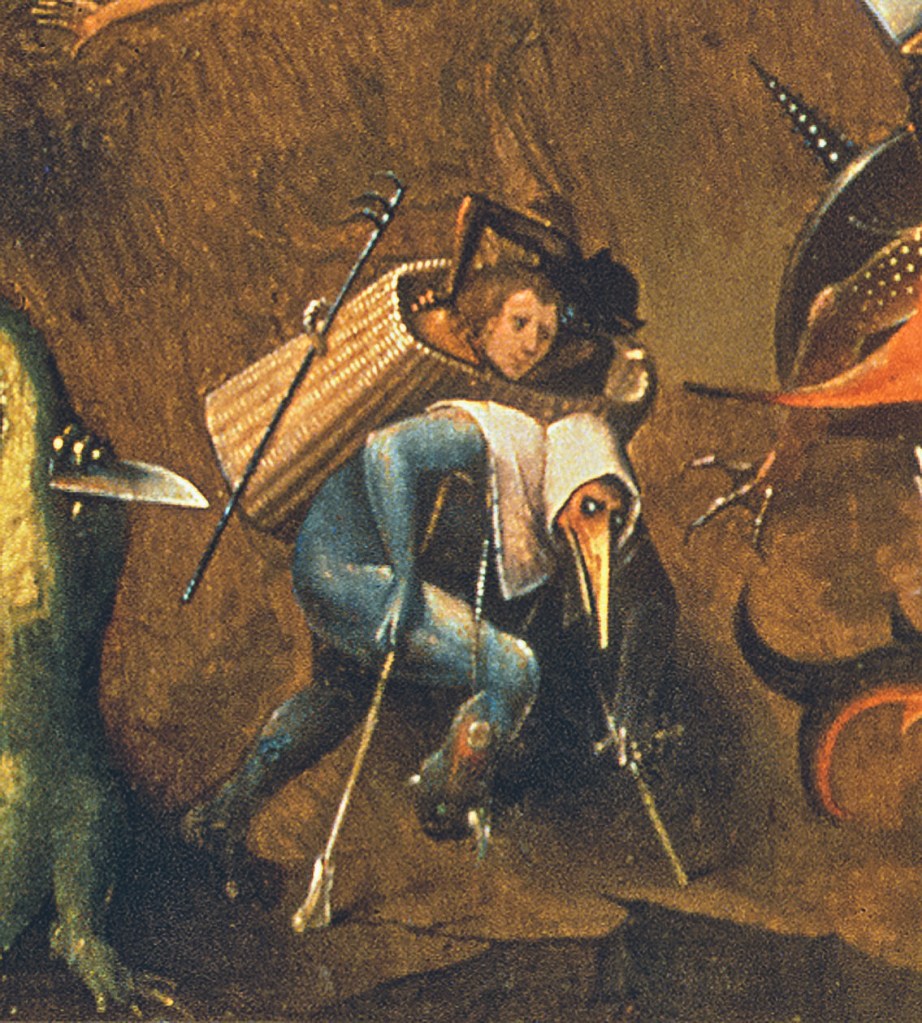
His works show us a world very different from those of his contemporaries. Forgotten superstitions of the Middle Ages come alive again through demons, witches, and dark spirits.
Bosch often mocked religious figures in his paintings, which made people believe he was against the Church. He painted many images of hell, yet he rarely showed heaven. When he did, it was usually in the context of Adam and Eve, the Creation, or the story of Original Sin.
To Bosch, the world was a dark and sinful place. Because of this view, some thought he was connected to a conservative religious group that still believed in old traditions and superstitions.
He painted with very fine brushes and often worked with oil or tempera on wooden panels. These materials were common at the time, but Bosch’s level of detail was truly rare.
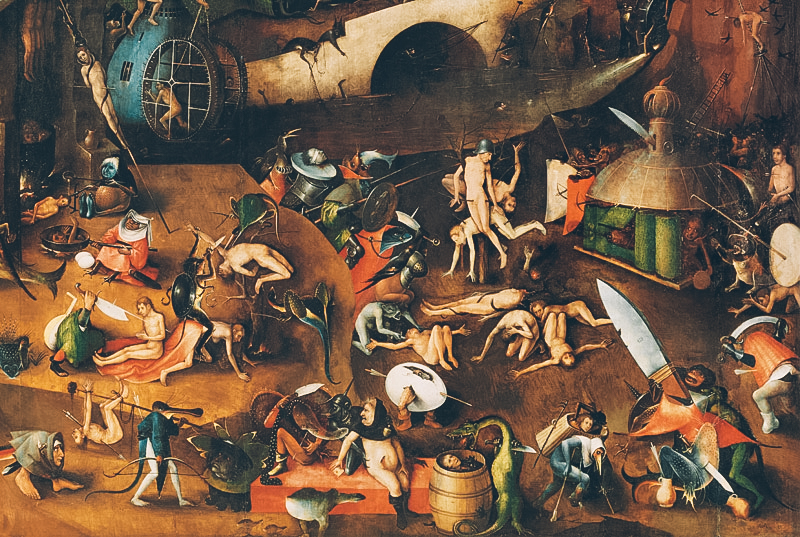
What was Bosch really thinking when he painted such wild scenes? Was he mocking old beliefs or laughing at the people who believed in them? Since we know very little about his personal life, the best way to understand him is by looking closely at his work.
One of the best examples is The Last Judgement, a large triptych (a painting in three parts, with a main panel and two side wings) made with oil on wood.
Bosch was not a typical Renaissance artist. In fact, he was the opposite. His works do not show the usual Renaissance light and perspective. Instead, they lead us into his own strange and dreamlike world. That is why many call him the father of surrealism. The more we understand him, the more we move away from the Renaissance and into Bosch’s unique imagination.
When the wings of The Last Judgement are closed, we see two saints painted in grey tones, which makes them look like stone statues. This style is called grisaille. On the right is St. Bavo, surrounded by poor and needy people. Behind him is a beautiful view of the city of Ghent. I love this detail, because I love that city.
On the left wing is St. James, shown as a traveler on a spiritual journey. He represents a faithful pilgrim.
Even though Bosch gives us many details, the coats of arms below these figures are left blank. It is believed that the person who commissioned the painting died before it was finished.
When we open the triptych, we see a large and very complex scene.
In the left panel, we see God placed in the sky, sitting in glory among the clouds. But if we look closely, we see hundreds, maybe thousands of angels fighting each other. This part is known as The Fall of the Rebel Angels. These are angels who followed Lucifer and were cast out of heaven into hell.
At the bottom of this panel, we see the Creation of Adam and Eve. Just above that is the scene where they eat the forbidden fruit. Above that, we see the moment an angel sends them away from Eden and into the world. One small but striking detail breaks the order of this paradise. On the far left, a creature is eating another creature.
In the central panel, Jesus sits at the top. On his sides are Mary, John the Baptist, the Apostles, and angels blowing golden trumpets to announce Judgment Day. Below them is a strange area, possibly limbo or purgatory. Some sources call it the edges of hell. Here we see the seven deadly sins being acted out. The scene is filled with suffering, punishment, and dark fantasy. It is both brutal and poetic.

One famous detail is a woman walking on a rooftop, almost like a fashion model, surrounded by strange creatures and musical instruments. The setting suggests this is a brothel. A blue creature plays an instrument that is part of its own body. This shows how Bosch used music as a symbol of temptation and excess.
Below this rooftop, we see a large man being force-fed from a green barrel. If we look closely, we see a funnel on top of the barrel and a demon urinating into it through a window. This is the sin of gluttony. Nearby, a big fish eats a smaller fish, showing how the powerful often take advantage of the weak.
Next to them, people are being boiled in a large metal pot. This scene represents the sin of greed. The figures are being cooked in their own riches.
Beside them, a frog-legged creature is preparing what looks like a human omelet. These disturbing scenes are classic Bosch. They are surreal and brutal but also deeply symbolic.
In the center of the panel, three knights represent the sin of wrath. One of them has a human head on top of his helmet. The chaos and flying arrows complete the scene.
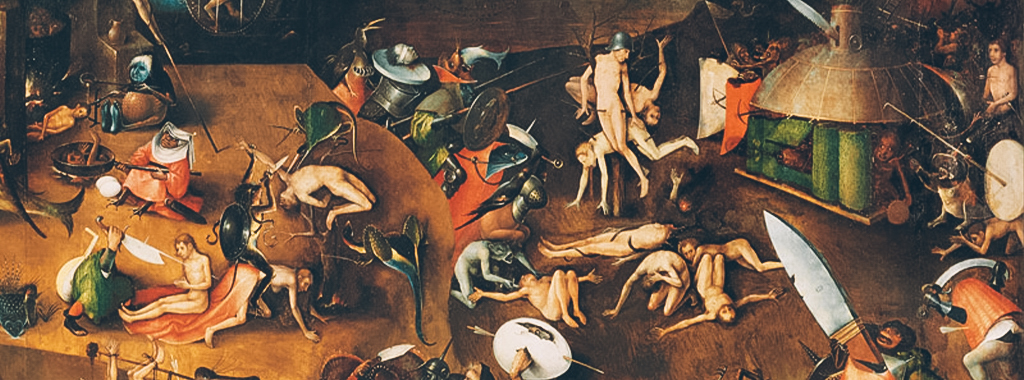
The right panel shows hell. Through the gates near the image of the devil, we see people in pain. Above them, tortured souls fall endlessly through fire and darkness. At the top, a city is in flames.

On the far left of the triptych, we had seen God. Now, on the bottom right, we see the devil. On the outside of this panel was the figure of St. Bavo, who ignored the poor people around him. Nearby was a severed foot. On the opposite panel, we had seen St. James, the faithful walker on the path of Christ.
 Özgür Kalender
Leave a comment