“Dada is an endless world war. Dada is a revolution without a beginning.” – Hugo Ball
These words by Hugo Ball reflect the heart of Dada, a movement born out of chaos and resistance. Dada used art as protest. While some critics argue that Dada was simply a product of the Industrial Age and not uniquely revolutionary, this perspective overlooks its fundamental differences from its contemporaries.
In the Industrial Age, art became embedded in daily life. Movements like Bauhaus and De Stijl created objects such as furniture and home designs under the label of art. Dada did not blend into everyday life like Bauhaus, nor did it appeal to the elite like Impressionism. In fact, it rejected both approaches. Dada was a reaction against political authority. While movements like Constructivism and Socialist Realism supported the vision of new political systems, often serving as tools of propaganda, Dada focused on critiquing the system itself. It refused to propose an alternative and instead emphasized rupture and confrontation.
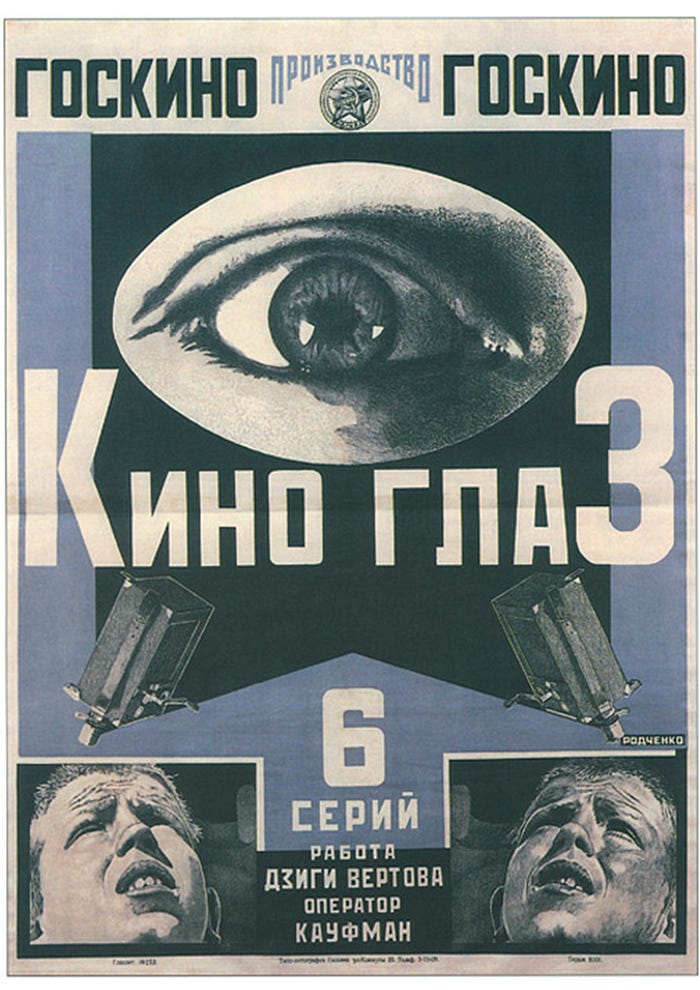
Alexander Rodchenko, one of the key figures of Russian Constructivism, was deeply influenced by Dada. His work, especially in photography, featured diagonal compositions that were seen as radical at the time. These diagonals broke traditional perspectives and brought dynamic tension into the frame. In his piece titled “Kino Eye – Life Caught Unaware,” Rodchenko applies collage with a graphic sense of design. Although the Cyrillic script may appear complex, once translated, the meaning becomes immediately clear.
In the image, we see two cameras aimed at the crumpled faces of two figures. Above them hovers a massive eye. The cameras, like weapons, point directly at kneeling figures, suggesting surveillance and control. The eye symbolizes the oppressive gaze of the Soviet government. The work is a powerful commentary on cinema being used as a tool of propaganda. Unlike pure Dadaist works that celebrated randomness and absurdity, here we see a focused and intentional critique. The use of blue, instead of the expected Soviet red, might represent a sliver of hope or the possibility of awakening and escape. It whispers a silent message: there is still a chance.
The bold type that spells out “Cinema Eye” reflects the power that cinema held at the time. It was not just a tool for art, but a means of social control. The placement of the text directly between the eye and the cameras reinforces its meaning. The gaze is not passive. It is weaponized. The image delivers a direct criticism of the propaganda machine and its visual tactics.
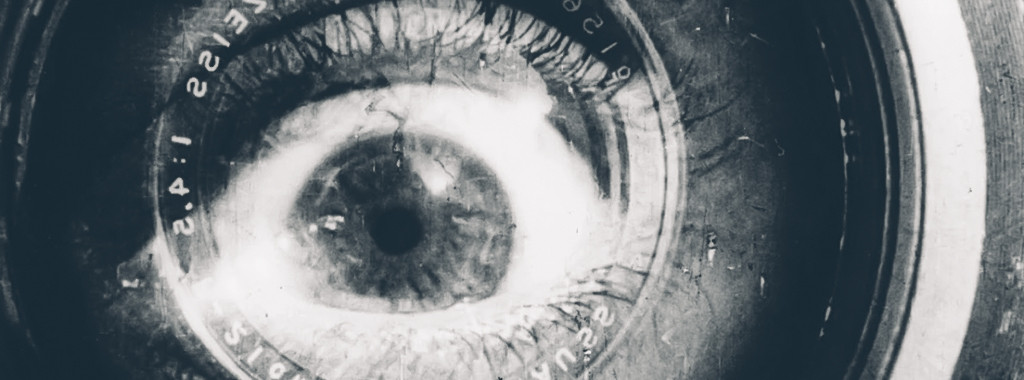
Dziga Vertov, another radical Soviet artist, developed the “Kino Eye” theory in the 1920s. He believed that the camera should not imitate the human eye but instead go beyond it. He rejected fiction and theatricality in favor of documentary and truth. According to Vertov, film should reveal life as it is, and the editing process should expose hidden realities. For him, cinema was a tool to reshape perception, not merely to reflect it.
Rodchenko’s design and Vertov’s film theory share the same revolutionary ambition. Both believe in the power of the lens to reveal truths and challenge structures of power. While Dada sought disruption without offering a clear path forward, Constructivism and Kino Eye believed in reimagining society through form and function.
Rodchenko’s poster captures this moment perfectly. Its geometry, symbolism, and critique of surveillance make it not just a work of art, but a political act. It stands at the intersection of Dada’s resistance and Constructivism’s vision. Together, they show how early twentieth-century artists used cinema and design not only to comment on the world, but to intervene in it.
Kino Eye is not just a phrase. It is a challenge. It asks us to see not with the eyes we are given, but with the ones we build.
 Özgür Kalender
Leave a comment